
How to Cite
Abstract
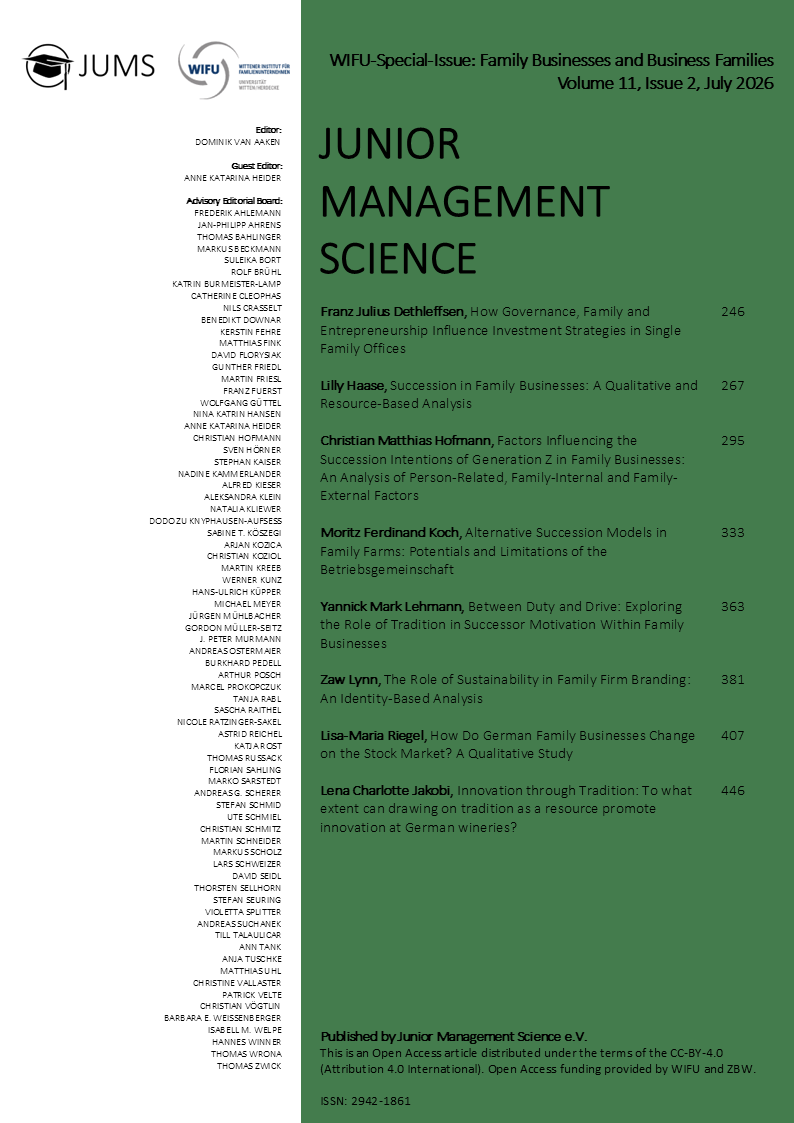
The structural succession problem in agricultural family farms highlights the lack of willingness of the succeeding generation to independently continue managing the parental farm. At the same time, however, there is often a strong emotional attachment to the farm, resulting in the desire to preserve the family farm. Traditional succession models do not provide adequate solutions to this succession dilemma, making alternative forms necessary that allow for a separation of ownership and farm management in the course of farm succession. Against this background, the thesis examines in what ways and under which conditions the German cooperative farming concept of the Betriebsgemeinschaft can contribute to the preservation of agricultural family farms. For this purpose, a qualitative research design with semi-structured interviews was chosen, which were analyzed using Mayring's qualitative content analysis. The results show that Betriebsgemeinschaften can represent a viable model for preserving agricultural family farms by ensuring operational continuity and maintaining ownership within the family, while farm management and farm operations are organized externally. The active involvement, continuous commitment, visible presence, and responsible assumption of the family's role as co-entrepreneur were identified as key prerequisites. At the same time, the findings indicate that the model places high organizational as well as personal demands on those involved and is susceptible to tensions and conflicts that may endanger long-term stability.
Keywords: family farms; farm succession; alternative succession models; betriebsgemeinschaften

This work is licensed under a Creative Commons Attribution 4.0 International License.
Copyright (c) 2026 Moritz Ferdinand Koch